Top Signs You Need Garage Door Service – Don’t Ignore These
Most garage door problems announce themselves before they become emergencies, and the signs usually fall into two groups: the ones that give you a week or two to schedule a repair, and the ones that mean you should stop running the door right now. A door that’s slightly slower than it used to be is the classic example. Sometimes that’s harmless age, sometimes it’s the last thing that happens before a cable snaps. Knowing which pattern you’re looking at is the whole game. If you’d rather not climb up and test it yourself, call us at (855) 595-5127 and we’ll take a look.
Key Takeaways
- Symptoms split into two buckets: “schedule this week” and “stop using the door now.” Treat them differently.
- A door that reverses before it touches the ground has two possible mechanical causes, and neither one fixes itself.
- In Riviera Bay’s humidity, white powder on springs and rust streaks at the hinges are early warnings, not cosmetic quirks.
- The 30-second balance test tells you more about your door’s real condition than any visual inspection.
- Opener strain is almost always a downstream symptom of friction in the door itself, not a failing opener.
Which warning signs give you time, and which mean stop now?
“Schedule this week” signs are the ones you can see and hear but that still let the door operate safely. “Stop now” signs mean a component is close to failing in a way that can drop the door or send parts flying.
Schedule this week:
- The door is noisier than it used to be, with squeaks, grinding, or a scraping sound at the hinges and rollers.
- It feels slightly heavier when you lift it by hand, or the opener seems to work harder to get it up.
- One panel has developed a small dent or the weather seal at the bottom is cracked and letting air in.
- The door drifts down a few inches after you open it, then settles.
- The opener’s light flickers or the remote only works from close range.
Stop using the door now:
- A spring is visibly broken, hanging, or has separated into two pieces.
- You can see a frayed or snapped cable dangling on either side of the door.
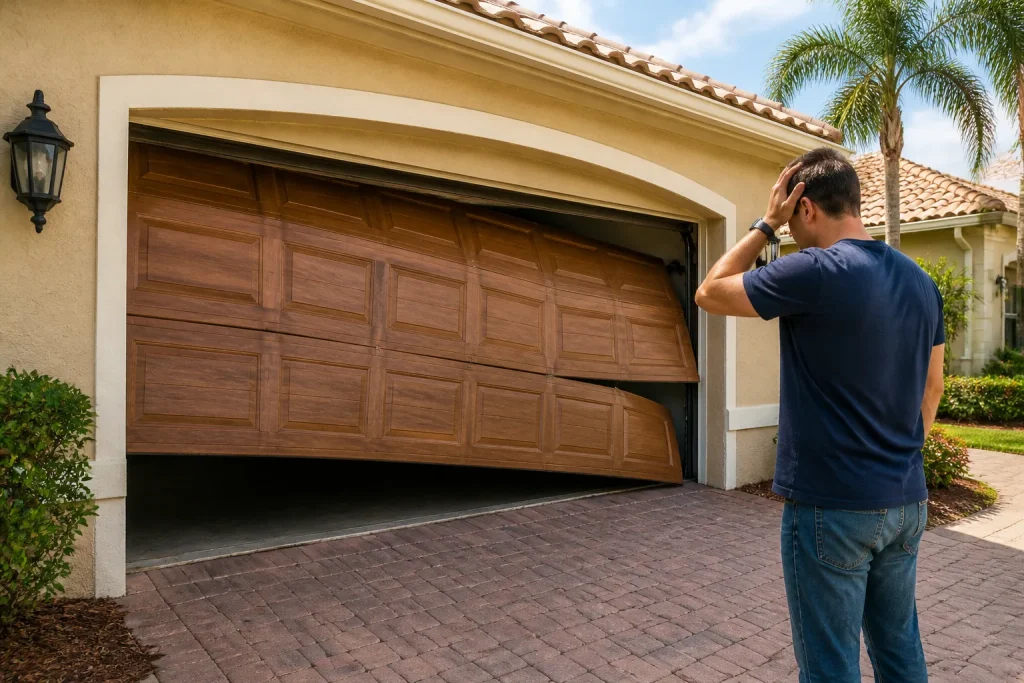
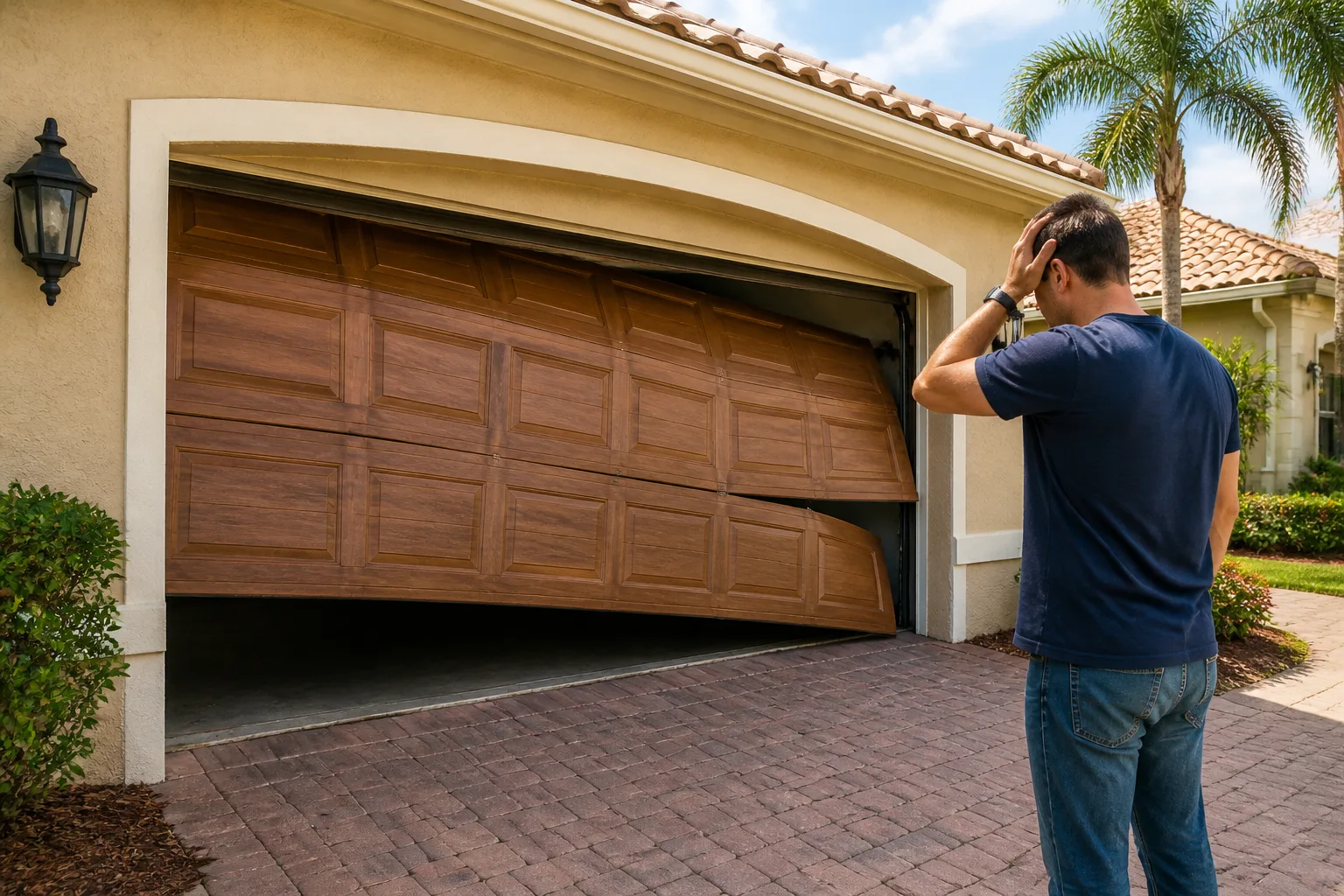
- The door is crooked, with one side higher than the other, and won’t close flush.
- It slams down or free-falls instead of lowering in a controlled way.
- You hear a loud bang from the garage and the door won’t open at all.
That last group is where our Garage Door Repair Riviera Bay team gets called most often, and for good reason: a broken spring or a snapped cable can turn a door weighing well over a hundred pounds into a falling object. Springs are the most dangerous part of a garage door, and we handle them so you don’t have to. Do not try to manually lift a door with a broken spring and do not attempt to unwind or remove one yourself; those parts are under extreme tension and can cause serious injury.
Why does the door reverse before it hits the ground?
A door that goes down, stops, and springs back up is not just being sensitive, and turning the opener’s reverse adjustment up to force it shut is the wrong fix. In our experience, there are two mechanical causes behind this behavior, and ignoring either one leads to the same place: the door eventually jams or won’t close at all.
- Something in the door’s path or track. A small object on the floor, a slightly bent track, or a roller that’s come loose can trip the safety sensors or the door’s internal force limit. This is the easier of the two to correct, and it’s often the first thing a technician checks.
- Binding or friction in the mechanism. A worn hinge, a dry roller, or a misaligned track makes the door harder to push down than the opener expects, so its force sensor reads resistance and reverses. This is the one homeowners miss, because it doesn’t always look broken. It just feels a little stiff.
Left alone, friction keeps building. The opener works harder, the door gets harder to move, and eventually the door reverses on every attempt or refuses to close at all. If your door is doing this in Riviera Bay, it’s a good moment to book a garage door repair before it stops responding entirely. We diagnose first, then recommend, so you’re not paying for a fix the door doesn’t need.
What does Riviera Bay humidity do to a garage door?
Riviera Bay’s warm, humid weather works on garage door hardware slowly and steadily, and the signs show up in places most people don’t think to look. Humidity doesn’t usually break a door in one dramatic moment. It wears the parts down until something gives.
- White powder on the springs. That chalky residue is early oxidation on the spring coating. It’s not an emergency on its own, but it tells you the spring’s protective finish is breaking down. Have it checked at your next service so a weakening spring gets caught before it snaps.
- Rust-colored streaks on the panels. Those brown drip lines below the hinges come from corroding metal working its way down the door. Left alone, a rusted hinge stops pivoting freely, which adds friction to every open and close.
- Wood door sections that swell and stick. Seasonal humidity expands wood panels, and a door that rubs against its frame gets harder for the opener to lift. A door that sticks in the wet months often keeps sticking after the dry season arrives.
- Seals that harden and crack. The bottom weather seal takes the brunt of humidity and sun. A cracked seal lets moisture and pests in and lets cooled air out.
None of these are reasons to panic. They’re reasons to look. A door that’s showing any of these in Riviera Bay is a good candidate for an inspection before the problem grows into a snapped part or a stuck door.
How do you do a 30-second balance test?
The balance test is the single most useful thing a homeowner can do, and it reveals more about a door’s condition than a visual once-over ever will. It tells you whether the springs and the door’s weight are in balance, which is the foundation of safe operation.
- Close the door and disconnect the opener using the release cord (usually a red handle).
- Lift the door by hand to about halfway up.
- Let go and watch what it does.
What the result means:
- It stays put. Your door is balanced. The springs and hardware are doing their job.
- It drifts down slowly. The springs are getting weak. That’s a “schedule a visit this week” result, not an emergency.
- It falls or drops fast, or it’s very hard to lift. That’s a “call now and stop using the door” result. A door that won’t hold its position has a spring or cable problem that can fail without warning. Do not force it back up by hand.
If the door is already working with a broken spring or visible cable damage, skip the test entirely and call a pro. Springs are under heavy tension even when they look calm, and this isn’t a job for a homeowner with a pair of gloves and a YouTube video.
Why is the opener straining, and why isn’t it the real problem?
Most “my opener is failing” calls turn out to be a door problem, not an opener problem. When a door is hard to move, the opener has to work harder to drag it up and push it down. That extra effort shows up as a strained motor, a remote with shrinking range, a light that flickers, or a door that reverses partway. Homeowners read those symptoms as the opener dying, but the opener is usually just the messenger.
That distinction matters because replacing an opener won’t fix a door that’s binding in its track. The new unit will strain against the same friction, and it won’t last as long as it should. Whether the system is a LiftMaster, a Chamberlain, or a Genie, the first step is always to check the door’s mechanical health: the springs, rollers, hinges, and track. If the door moves by hand the way it should, then we look at the garage door opener repair side, including the electronics and any smart-home controls.
In our experience, correcting the underlying friction solves the “opener problem” more often than not, and it costs less than a new unit.
When should you call a pro?
You should call a professional any time the door won’t move freely by hand, when a spring or cable is visibly damaged, or when the door reverses and you’ve already cleared the obvious objects from its path. Those three situations are outside the safe reach of a homeowner. Minor squeeaks and a worn seal are fine to note and schedule, but a door that falls, jams, or reverses on every cycle needs a trained eye before anyone uses it again.
Our technicians have up to 13 years of experience, and we work on whatever system is already on your house, from a LiftMaster opener to a Clopay or Amarr door, so you don’t have to hunt for a brand specialist. If you’re facing replacement rather than repair, we also handle full garage door installation and can measure your opening and give you a written price before any work begins.
Related services in Riviera Bay: spring repair, opener repair, panel replacement, and full door installation. One call covers the whole door.
The Bottom Line
The signs that give you time are noise, drift, and a door that feels heavier than it used to. The signs that mean stop are anything involving a broken spring, a damaged cable, or a door that falls instead of lowering in a controlled way. The balance test sorts the two apart quickly. If Riviera Bay’s humidity is starting to show on your springs and hinges, that’s a reason to book a look, not to panic. In our experience, the doors that get caught early are the ones that avoid the emergency call.
If you’re in Riviera Bay and need help, Garage Door Repair Riviera Bay offers free estimates. We diagnose first, then recommend. Call (855) 595-5127, and we’ll get you a straight answer on what your door actually needs.
Frequently Asked Questions
The most common signs are a door that’s noisier than usual, reversing before it hits the ground, drifting down after opening, or showing white powder on the springs and rust streaks at the hinges. Any one of these is worth a look; two or more together mean it’s time to schedule service. Call (855) 595-5127 for a free estimate.
For time-sensitive failures like a broken spring, a door stuck open, or a security compromise, we offer emergency garage door service, so call us and we’ll work to get out quickly. Standard repairs and quieter issues can usually be scheduled within a few days. Either way, you’ll get a written price before any work starts, and you’ll know the cost before we begin.
No. We quote the job upfront and agree on the price with you before any work starts. If we find a second issue while we’re there, we’ll tell you and give you a separate price to approve, and you decide whether to move forward. You won’t get a surprise invoice later.
The local pros we connect you with are licensed and insured as their state requires, and our technicians have up to 13 years of experience. We work on all the major brands, including LiftMaster, Chamberlain, Genie, Clopay, Amarr, Wayne Dalton, Craftsman, and Raynor, so we diagnose your existing system rather than push a particular brand.
Written by the team at Garage Door Repair Riviera Bay.
Need Garage Door Help?
Call Garage Door Repair Riviera Bay - the local pro we connect you with is licensed and insured, here with fast after-hours help in Riviera Bay.
(855) 595-5127